Watch my Ovonic X4 review
Video published on
I have been using the Ovonic X4 for a long time and still do not need another charger. I own plenty of batteries with different capacities and connectors, so having four channels in one unit is convenient. I bought it for my own use: this review reflects that experience, rather than a comparison of every current charger or a laboratory test.
More useful than simply saying I like it is explaining when 500 W are enough and when you might hit a limit. Four outputs do not mean that each one has the full power available.
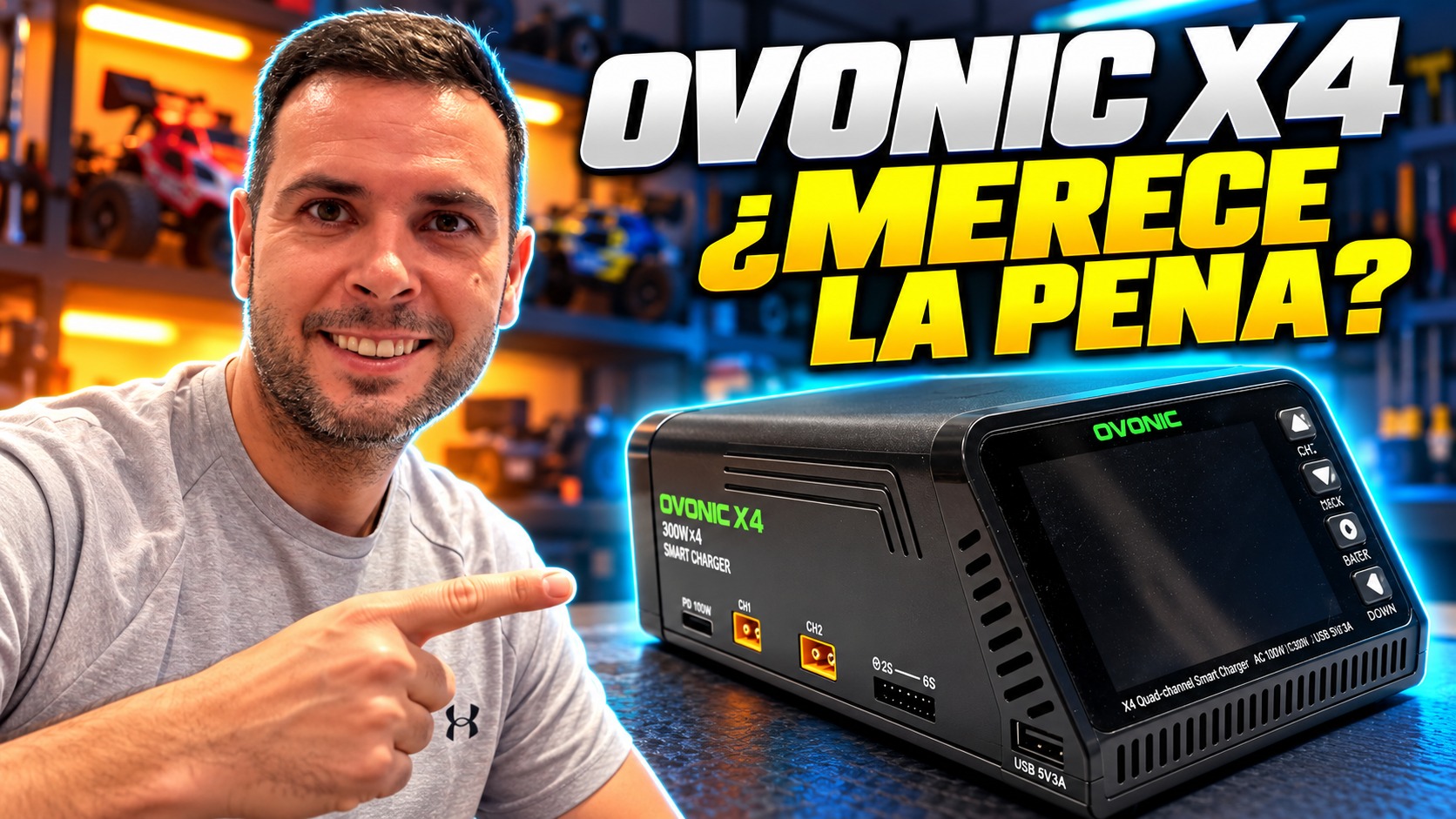
Why I chose the Ovonic X4
After using other chargers, I wanted a simpler setup. Several small chargers, an external power supply, cables and a case did not suit my preferences for convenience and budget.
The X4 combines four channels and mains power in one box. In my normal use, charging at 1C, I have not missed having more power. That does not mean it can charge any battery at any rate: the numbers matter.
Its colour display uses physical buttons rather than touch controls. That works for me. I have not missed an app or Bluetooth notifications either, although someone else may value those features more.
The 500 W are shared
A single output cannot deliver 500 W: its maximum is 250 W, even with the other three outputs unused.
The manufacturer’s specifications list the limits below. These are maximum power figures, rather than a guarantee that the selected current will be maintained throughout charging:
| Channels in use | Maximum power per channel |
|---|---|
| One or two | 250 W |
| Three | Approximately 167 W |
| Four | 125 W |
There is also a 15 A limit per channel. Both current and power limits apply. The three-channel figures are rounded; the advertised total remains 500 W.
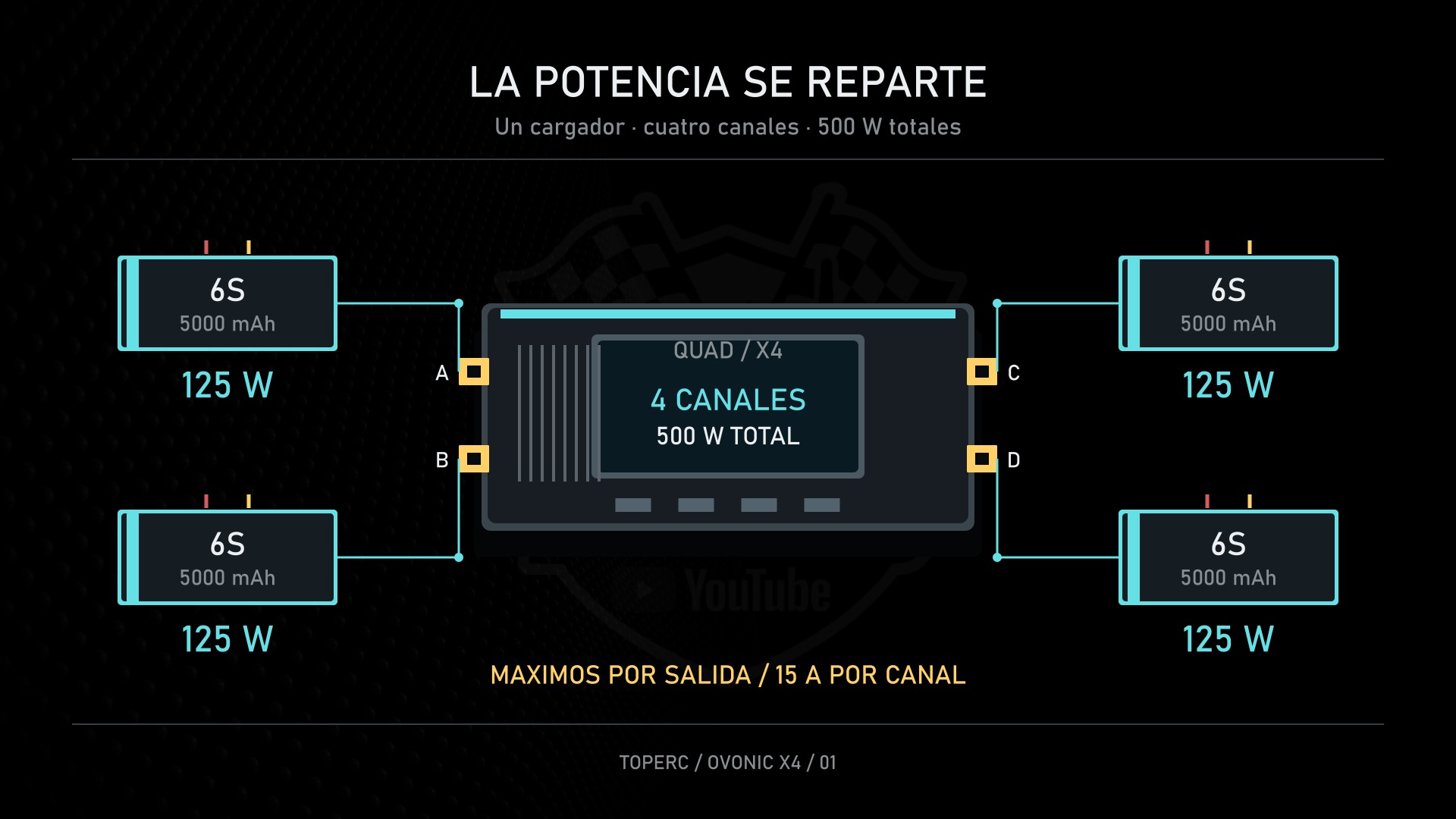
Frame from the animated infographic made for the review. Power allocation depends on how many channels are in use. The original graphics are in Spanish.
Example: a 5000 mAh 6S LiPo
First convert capacity to amp-hours: 5000 mAh = 5 Ah. Charging at 1C means 5 A; at 2C it means 10 A, provided the battery manufacturer allows that rate.
A conventional 6S LiPo reaches 25.2 V at full charge: six cells at 4.2 V each. Multiply voltage by current:
| Example rate | Current | Power at 25.2 V |
|---|---|---|
| 1C | 5 A | 126 W |
| 2C | 10 A | 252 W |
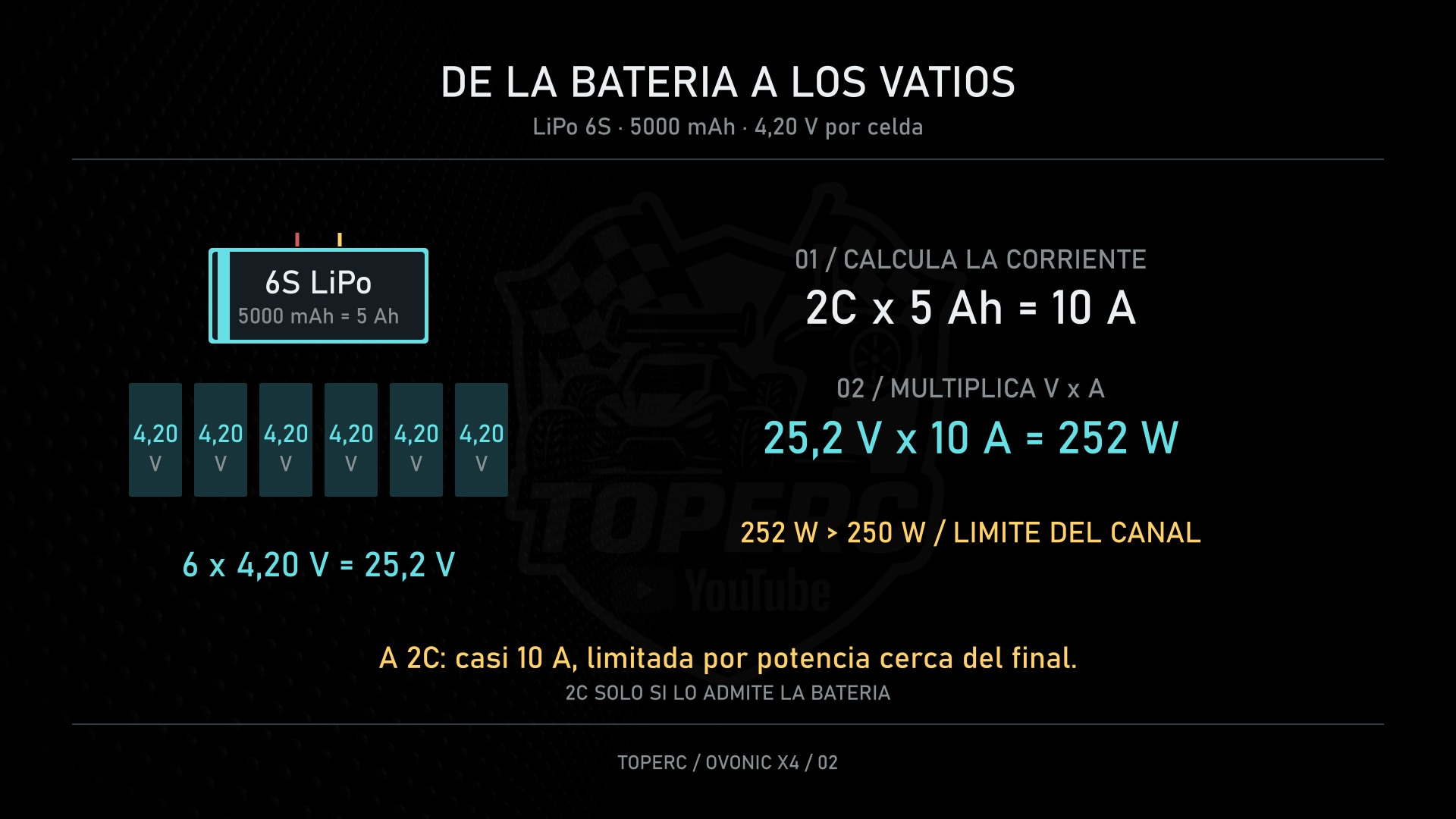
At 2C, 252 W slightly exceeds the 250 W maximum of one output. With four channels running, even the 126 W needed for the 1C example is slightly above the 125 W available per channel.
These calculations explain the limit near maximum voltage; they are not measured charging times. Current falls during the final charging stage, so doubling the rate does not necessarily halve the total time.
Current can be a limitation too
Another infographic uses a 6700 mAh 4S battery at 3C as a theoretical example:
- 6.7 Ah × 3 = 20.1 A charging current.
- 4 × 4.2 V = 16.8 V at full charge.
- 16.8 V × 20.1 A = approximately 337.7 W.
That exceeds both limits of an output: 15 A and 250 W. The unit for current is A, not Ah; Ah measures capacity.
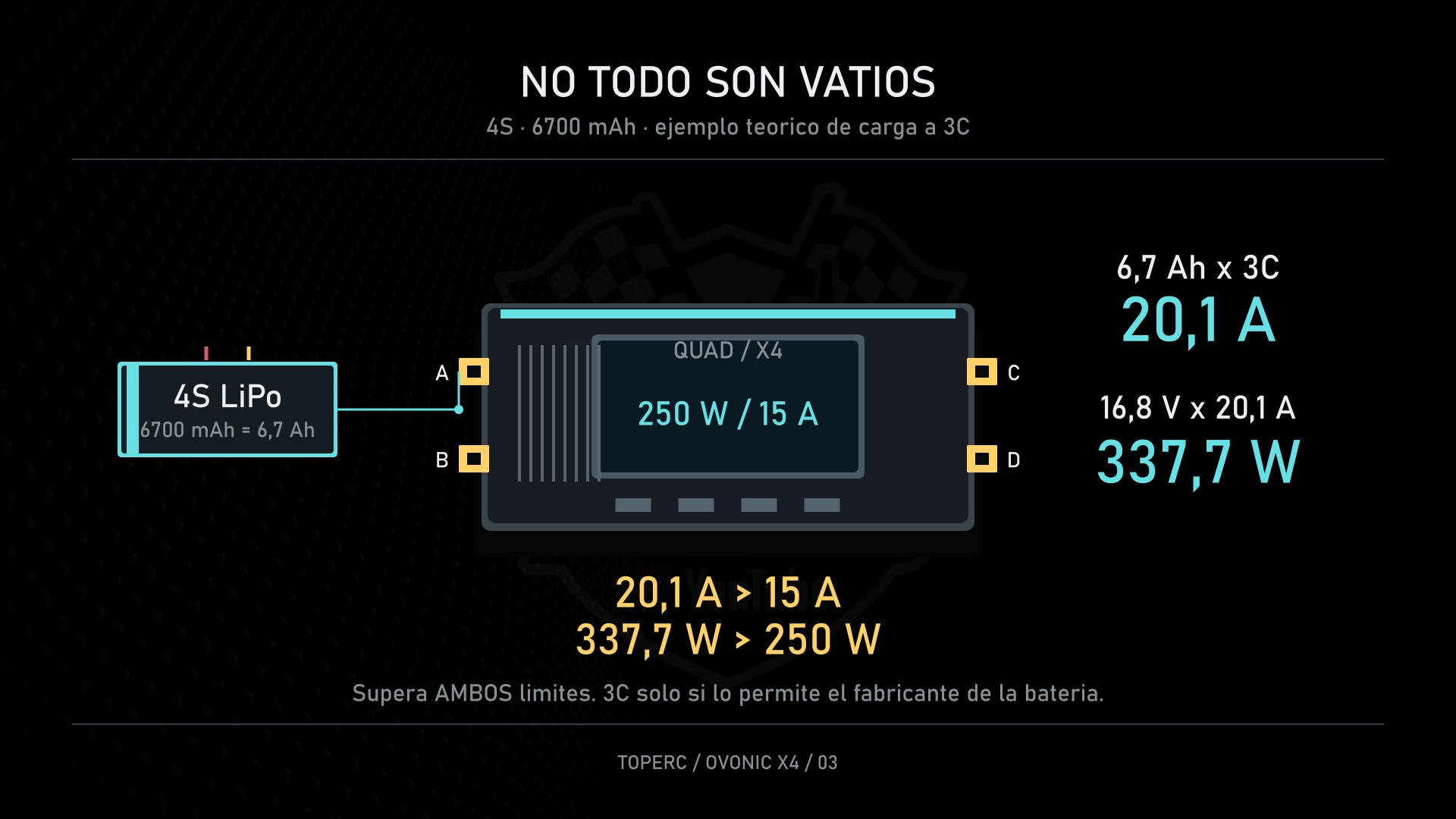
This is not a recommendation to charge at 3C. Follow the battery manufacturer’s permitted rate and conditions, select the correct chemistry and cell count, and supervise charging.
Digital Power and connectors
One feature I like is Digital Power. It lets an output act as an adjustable power supply for an accessory, with voltage and current settings. Compatible workshop equipment, such as tyre warmers or a tyre truer, may benefit from it.
A matching connector alone does not establish compatibility. Check voltage, polarity and power requirements first. Also check which battery adapters you need: I have had to add to my own set, particularly for some bullet connectors.
Who does it suit?
It suits me because I use many batteries, want four channels and prefer an integrated unit. If you charge large packs at high rates, or need more than 6S per battery, you will need a setup that meets those requirements.
My advice is to start with your most demanding battery. Calculate the charging current and power at maximum voltage, then account for how many packs you want to charge simultaneously. After that, consider connectors, power supply and convenience.
I made this mistake with an old iMAX B6 setup: I did not properly understand what my batteries required and ended up burning out the power supply. That is why I consider this calculation more useful than focusing on the biggest wattage number on the box.
The X4 still does what I need. The right purchase is the one that fits your batteries and charging habits, rather than necessarily the charger with the highest advertised power.
Technical reference
Power, current and battery compatibility limits were checked against the official Ovonic X4 product specifications. Usage impressions and examples come from my review. No current price is quoted because it varies by shop and region.